Behind the Scenes: Building the Future of Clean Streets
A personal journey through the early development stages of our eco-friendly outdoor vacuum cleaner project
When I first envisioned a powerful yet sustainable outdoor vacuum cleaner, I knew the journey ahead would be challenging. But I also knew it was necessary. Our streets, parks, and public spaces deserve better than traditional cleaning methods that are loud, polluting, and inefficient. This is the story of how that vision began to take shape — from initial sketches to our first working prototype.
Every great innovation starts with a simple question. Mine was: "Why can't we clean our outdoor spaces as efficiently and quietly as we clean our homes?" That question led me down a path of research, experimentation, and countless late nights at my workshop. Today, I want to share that journey with you.
The Spark of Inspiration
The idea came to me during a morning walk through my neighborhood park. I watched as city workers struggled with heavy, gas-powered leaf blowers that created more noise pollution than actual cleaning. The machines were inefficient, pushing debris from one spot to another rather than collecting it. Meanwhile, the fumes from the gas engines hung in the air, contradicting the very purpose of maintaining a clean, healthy environment.
That's when it hit me: we needed a solution that actually collected debris, operated quietly, and ran on clean energy. A vacuum cleaner for the outdoors — but not just any vacuum. It needed to be powerful enough to handle everything from cigarette butts to fallen leaves, compact enough to navigate sidewalks and park paths, and sustainable enough to align with our environmental goals.
"The best innovations solve problems we've learned to accept as normal. I refused to accept that outdoor cleaning had to be loud, polluting, and inefficient."
— Stephanie, Project Founder
I spent the next few weeks researching existing outdoor cleaning equipment, studying industrial vacuum technology, and talking to city maintenance workers about their biggest challenges. The feedback was consistent: they needed something more efficient, quieter, and better for the environment. The market gap was clear, and I was determined to fill it.
From Concept to Paper: The Design Phase
Armed with inspiration and research, I began sketching. My workshop table became covered with drawings — some practical, others wildly ambitious. I experimented with different form factors: should it be handheld or wheeled? How large should the collection bin be? Where would the battery pack fit? Each sketch brought new questions and new possibilities.
Key Design Considerations
Several critical factors shaped the early design process:
- Portability vs. Power: The unit needed to be light enough for one person to maneuver but powerful enough to handle heavy debris like wet leaves and gravel.
- Battery Life: Electric power was non-negotiable, but the battery had to last through a full work shift without compromising suction strength.
- Noise Reduction: Traditional outdoor equipment operates at 90-100 decibels. I aimed for under 70 decibels — quieter than a normal conversation.
- Durability: Outdoor conditions are harsh. The design needed to withstand rain, dust, temperature fluctuations, and daily wear and tear.
- Ease of Maintenance: City workers needed to be able to empty the collection bin and perform basic maintenance without specialized tools or training.
After dozens of iterations, I settled on a wheeled design with a wide intake nozzle, a 15-liter collection bin, and a modular battery system. The form factor resembled a compact lawn mower but with the suction power of an industrial vacuum. It was ambitious, but the design felt right.
I created detailed technical drawings, specifying dimensions, materials, and component placements. Every measurement mattered. The intake nozzle needed to be wide enough to capture large debris but designed to create sufficient airflow for strong suction. The wheels had to be large enough to navigate uneven terrain but not so large that they made the unit unwieldy. Balance was everything.
Choosing Sustainable Materials
Material selection proved to be one of the most challenging aspects of the project. I was committed to sustainability, but I also needed materials that could withstand the rigors of outdoor use. This meant finding the sweet spot between environmental responsibility and practical durability.
The Housing and Frame
For the main housing, I explored several options. Traditional plastics were durable but environmentally problematic. Metal was strong but heavy and prone to rust. After extensive research, I discovered recycled high-density polyethylene (HDPE) — the same material used in milk jugs and detergent bottles. When properly processed, recycled HDPE offers excellent durability, weather resistance, and a significantly lower environmental footprint than virgin plastics.
The frame required more structural integrity, so I opted for recycled aluminum. Aluminum is infinitely recyclable without losing quality, and its strength-to-weight ratio made it perfect for our needs. Using recycled aluminum instead of new production reduces energy consumption by 95% — a massive environmental win.
The Collection System
The collection bin needed to be transparent (so users could see when it was full), durable, and easy to clean. I chose recycled polycarbonate, which offers excellent impact resistance and clarity. The bin design includes a quick-release mechanism, allowing workers to empty it in seconds without tools.
For the filtration system, I developed a multi-stage approach using washable, reusable filters made from recycled polyester mesh. Unlike disposable filters that create ongoing waste, these filters can be cleaned and reused hundreds of times. The primary filter captures large debris, while a secondary HEPA-grade filter traps fine particles and allergens, improving air quality rather than degrading it.
Power and Electronics
The battery system presented unique challenges. I needed high capacity, long life, and environmental responsibility. Lithium-ion batteries offered the best performance, but their environmental impact concerned me. After consulting with battery specialists, I designed a modular system using lithium iron phosphate (LiFePO4) batteries — a safer, longer-lasting, and more environmentally friendly alternative to standard lithium-ion.
The modular design means batteries can be easily replaced or upgraded as technology improves, extending the product's overall lifespan. Additionally, I partnered with a battery recycling program to ensure end-of-life batteries are properly processed and their materials recovered.
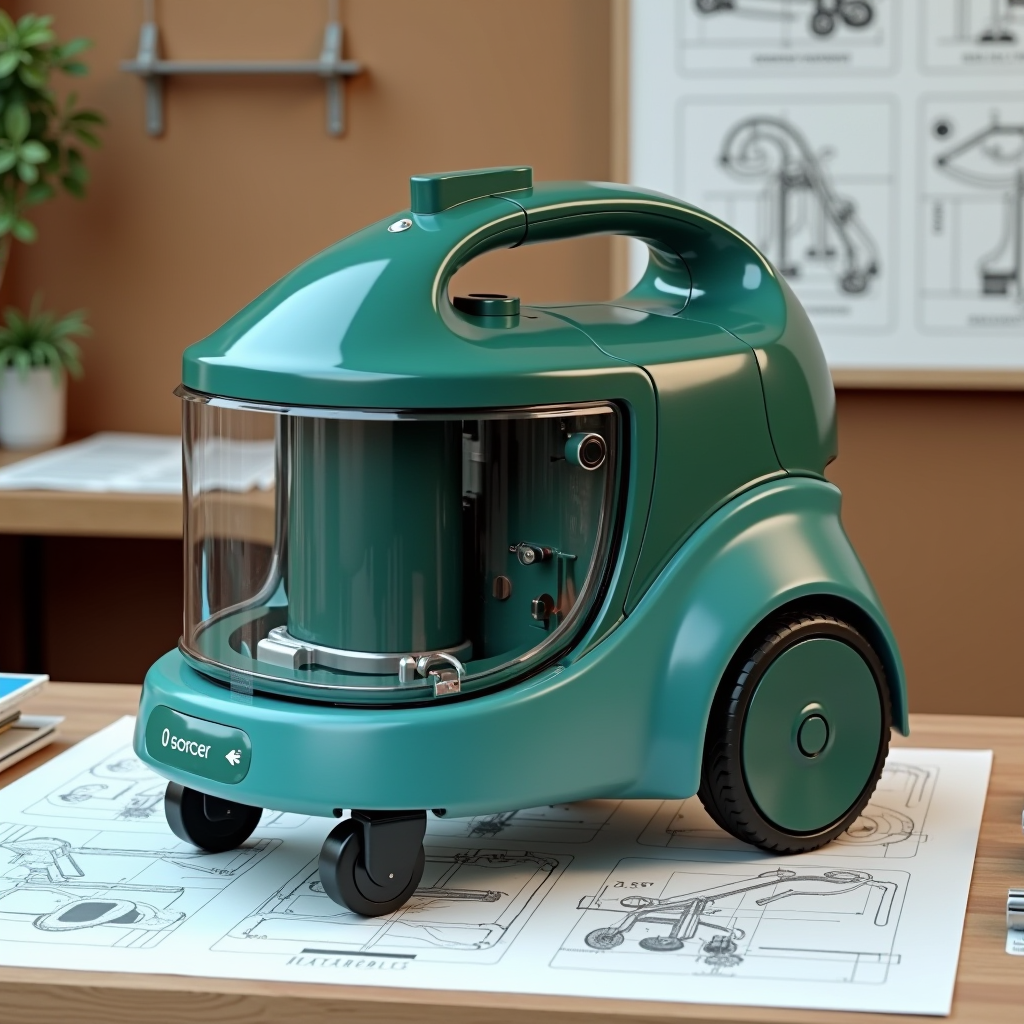
Early prototype design mockup showing the modular construction and sustainable material choices
Engineering Challenges and Solutions
Turning designs and material choices into a working prototype revealed challenges I hadn't anticipated. Each problem required creative problem-solving and often sent me back to the drawing board. Here are some of the biggest hurdles we faced:
Challenge 1: Balancing Suction Power with Battery Life
The motor needed to generate enough suction to lift wet leaves and small stones, but powerful motors drain batteries quickly. My initial calculations suggested we'd get only 45 minutes of runtime — far too short for practical use.
Solution: I implemented a variable power system with three modes: Eco (for light debris), Standard (for general use), and Boost (for heavy-duty cleaning). This allows users to conserve battery when full power isn't needed. Additionally, I optimized the airflow path to reduce resistance, improving efficiency by 30%. The result: 3-4 hours of runtime in Standard mode, with the option to swap batteries for extended use.
Challenge 2: Preventing Clogs
Outdoor debris is unpredictable. During early tests, the intake nozzle frequently clogged with tangled leaves, plastic bags, and other materials. Each clog required stopping work and manually clearing the blockage — unacceptable for a commercial product.
Solution: I redesigned the intake system with a rotating brush bar (similar to a vacuum cleaner) that breaks up clumps and prevents tangles. The nozzle also features a wider opening with strategically placed guide vanes that direct debris into the collection bin while preventing jams. In testing, this reduced clogs by 85%.
Challenge 3: Noise Reduction
Even with an electric motor, the initial prototype was louder than I wanted — around 78 decibels. The noise came from multiple sources: the motor itself, air turbulence in the intake system, and vibrations in the housing.
Solution: I added sound-dampening foam made from recycled materials around the motor housing. I also redesigned the airflow path to reduce turbulence, which significantly decreased noise. Finally, I mounted the motor on rubber isolators to minimize vibration transfer. These changes brought the noise level down to 68 decibels — quieter than a dishwasher and well within our target range.
Challenge 4: Weather Resistance
Outdoor equipment faces rain, dust, extreme temperatures, and UV exposure. Electronics and batteries are particularly vulnerable to moisture, while plastics can degrade under constant sun exposure.
Solution: All electronic components are housed in sealed, IP65-rated enclosures (protected against dust and water jets). The housing material includes UV stabilizers to prevent degradation from sunlight. Gaskets and seals at all connection points prevent moisture intrusion. We tested the prototype in simulated rain, dust storms, and temperature extremes from -10°C to 45°C. It passed every test.
Early Prototype Testing Results
With the first working prototype complete, it was time for the moment of truth: real-world testing. I partnered with a local park maintenance team who agreed to test the unit during their regular cleaning routines. The feedback was invaluable.
What Worked Well
The testing revealed several successes:
- Suction Power: The unit easily picked up everything from cigarette butts to wet leaves to small gravel. Workers were impressed by its ability to handle debris that would clog traditional equipment.
- Noise Level: At 68 decibels, the vacuum was quiet enough that workers could have normal conversations while operating it. Park visitors barely noticed it was running.
- Battery Life: In Standard mode, the battery lasted 3.5 hours — enough for a full morning shift. The quick-swap battery system meant workers could continue with a fresh battery after lunch.
- Ease of Use: Workers adapted to the unit quickly. The controls were intuitive, and the quick-release collection bin made emptying simple and mess-free.
- Maneuverability: The wheeled design navigated sidewalks, grass, and gravel paths with ease. The turning radius was tight enough for crowded areas.
Areas for Improvement
Testing also revealed opportunities for refinement:
- Weight Distribution: While the overall weight was manageable, the unit felt front-heavy when the collection bin was full. I'm redesigning the frame to better distribute weight.
- Filter Maintenance: The filters needed cleaning more frequently than expected when working in dusty conditions. I'm developing a self-cleaning filter system that uses reverse airflow pulses.
- Handle Ergonomics: After extended use, some workers reported hand fatigue. I'm adding adjustable handles and ergonomic grips to reduce strain.
- Collection Bin Capacity: In areas with heavy debris, the 15-liter bin filled quickly. I'm exploring a 20-liter option for high-volume applications.
Overall, the testing exceeded my expectations. The core concept proved sound, and the identified improvements are all achievable. The maintenance team was enthusiastic about the potential, with one worker commenting, "This is what we've been waiting for. It actually makes our job easier and better for the environment."
Personal Reflections and Lessons Learned
This journey has been one of the most challenging and rewarding experiences of my life. There were moments of frustration when designs didn't work, when materials didn't perform as expected, when I questioned whether this project was even possible. But there were also moments of pure joy — when the motor first powered on, when the prototype picked up its first piece of debris, when I saw the excitement in the maintenance workers' eyes during testing.
I've learned that innovation isn't about having all the answers from the start. It's about asking the right questions, being willing to fail, and persistently working toward a solution. Every setback taught me something valuable. Every challenge forced me to think more creatively. Every small success built momentum toward the larger goal.
I've also learned the importance of staying true to core values. It would have been easier to use conventional materials, to compromise on sustainability for the sake of cost or convenience. But every time I was tempted to take shortcuts, I remembered why I started this project: to create something that genuinely makes the world better. That commitment to sustainability and quality has guided every decision, and I believe it shows in the final product.
"Building something new is scary. You're creating something that doesn't exist, solving problems that haven't been solved. But that's also what makes it exciting. Every day brings new challenges and new possibilities."
The support from this community has been incredible. Your encouragement, your questions, your suggestions — they've all contributed to making this project better. Knowing that people believe in this vision gives me the energy to push through the difficult moments and keep moving forward.
What's Next: The Road Ahead
We've come a long way from those initial sketches, but the journey is far from over. The prototype testing has given us a solid foundation, but there's still work to be done before we can move to production. Here's what lies ahead:
Immediate Next Steps
- Prototype Refinement: Implementing the improvements identified during testing — better weight distribution, enhanced ergonomics, self-cleaning filters, and increased bin capacity.
- Extended Testing: Conducting longer-term tests in various environments — urban streets, suburban parks, event venues — to ensure reliability across different use cases.
- Certification: Obtaining necessary safety and environmental certifications for commercial use.
- Manufacturing Partners: Identifying and vetting manufacturing partners who share our commitment to sustainability and quality.
- Cost Optimization: Finding ways to reduce production costs without compromising quality or sustainability, making the product accessible to more communities.
Long-Term Vision
Beyond the immediate goals, I envision a future where clean, quiet, sustainable outdoor cleaning is the norm rather than the exception. I see our vacuum cleaners in parks, on city streets, at outdoor events, and in commercial spaces worldwide. I see communities taking pride in their clean public spaces, knowing they're maintained in an environmentally responsible way.
I also see this project as a starting point for broader innovation in sustainable outdoor equipment. Once we've proven the concept with the vacuum cleaner, there are opportunities to apply similar principles to other outdoor maintenance tools — sweepers, pressure washers, lawn care equipment. The possibilities are endless.
But none of this is possible without continued support from people like you. Every contribution, every share, every word of encouragement brings us closer to making this vision a reality. Together, we're not just building a product — we're building a cleaner, quieter, more sustainable future for our communities.
Thank You for Being Part of This Journey
Thank you for taking the time to read about our progress. Your interest and support mean everything to this project. Innovation doesn't happen in isolation — it happens when passionate people come together around a shared vision. That's what we're building here: a community committed to creating positive change.
I'll continue sharing updates as we move forward. There will be more challenges, more breakthroughs, and more lessons learned. I'm excited to share this journey with you and grateful for your continued support.
Together, we're building a cleaner tomorrow. One innovation at a time.
With gratitude and determination,
Stephanie
Published on November 8, 2024
This article is part of our ongoing series documenting the development of the eco-friendly outdoor vacuum cleaner project. Stay tuned for more updates as we continue refining the prototype and moving toward production.